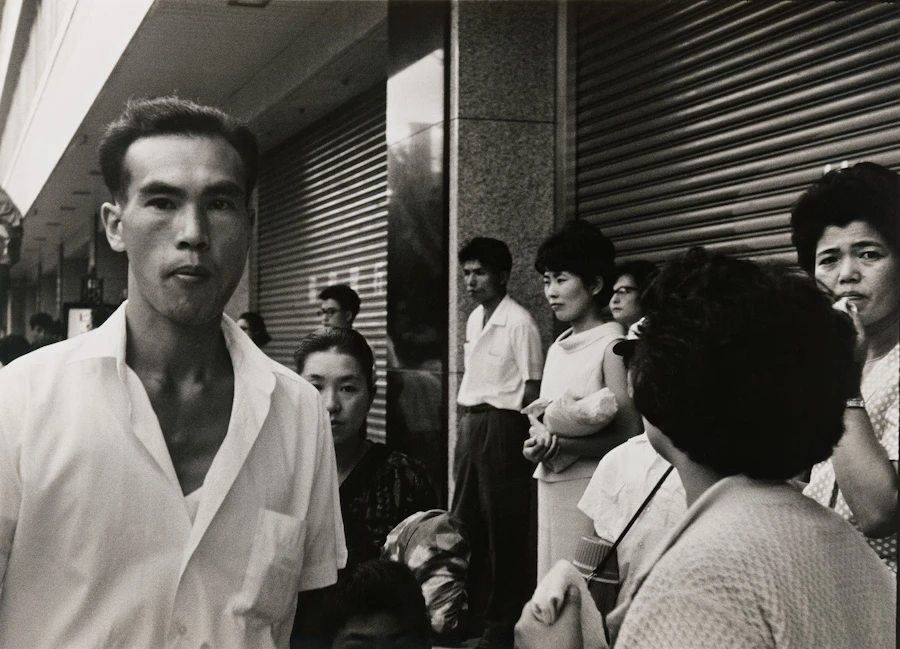
Kenji Ishiguro, Hiroshima Now, 1965
Lost and Found takes its title from the memory project organised by Japanese photographer Munemasa Takahashi in the wake of the earthquake and tsunami that hit the Pacific coast of Japan in March 2011. The project works with a vast accumulation of family photographs discovered in the ruins of the city of Yamamoto in the Miyagi prefecture. Damaged, marked or partly obliterated by the effects of water and mud, these snapshots spoke of a vanished world. An installation forming part of this project, a wall of ghosts, opens this exhibition devoted to the ambivalent power of images—images of a world already vanished or yet coming into being, images of a Japan in the grip of omnipresent catastrophe and seized at the same time by an explosive vitality endlessly renewed. The exhibition draws on the...
Lost and Found takes its title from the memory project organised by Japanese photographer Munemasa Takahashi in the wake of the earthquake and tsunami that hit the Pacific coast of Japan in March 2011. The project works with a vast accumulation of family photographs discovered in the ruins of the city of Yamamoto in the Miyagi prefecture. Damaged, marked or partly obliterated by the effects of water and mud, these snapshots spoke of a vanished world. An installation forming part of this project, a wall of ghosts, opens this exhibition devoted to the ambivalent power of images—images of a world already vanished or yet coming into being, images of a Japan in the grip of omnipresent catastrophe and seized at the same time by an explosive vitality endlessly renewed. The exhibition draws on the collection of the A Foundation to present a selection of works for the most part by women photographers, too often omitted from canonical accounts of Japanese photography. Among the photographers represented, figures such as Kenji Ishiguro, Ishiuchi Miyako or Hiromi Tsuchida have concerned themselves with the still tangible effects of the atomic bomb dropped on Hiroshima, while others, like Ryūji Miyamoto, Lieko Shiga and Munemasa Takahashi, have focused on such expressions of telluric forces as the Kobe earthquake of 1995 or the tsunami of March 2011. For counterpoint, the exhibition also includes a selection of photographic series from the 1970s and '80s, rarely shown or only recently rediscovered. There we find the flashy colour of takenoko-zoku dancers, the weekend heroes photographed by Noriko Shibuya; the dense crowds of Aomori’s Nebuta festival, photographed by Tatsuki Sugimoto; the televisual experiment of Masao Mochizuki and Mutsuko Yoshida; and the formal innovation of photographers like Nobuyoshi Araki, Satomi Nihongi, Yutaka Takanashi and Eiko Yamazawa. An exhibition ambivalently suspended, “half awake, half asleep in the water” in the words that Asako Narahashi chose as title for one of the series shown here, in which the artist, half submerged, reveals to us the instability of the world. Curator: Julien FrydmanOpening Hours
| Monday | Closed |
| Tuesday | Closed |
| Wednesday | Closed |
| Thursday | 13:00 - 18:00 |
| Friday | 13:00 - 18:00 |
| Saturday | 13:00 - 18:00 |
| Sunday | 13:00 - 18:00 |