Per Adolfsen
While talking to Per Adolfsen about his new exhibition with Nino Mier Gallery, the artist suddenly reflects: “Looking back, of all the things I’ve done throughout my art career, I feel these works are what I am. This is me.” The pencil drawings Adolfsen shows indeed connect the dots across his various artistic endeavors. Over the years, he has worked abstractly, explored surrealism, and created large, dark, hyper-Nordic expressionist paintings. But ultimately, these current pencil drawings of natural scenes mark a return to what he did, and loved, as a boy. It’s a full-circle moment for the artist. To understand how things reached this point, we need to rewind quickly to when the artist was 12 years old and first encountered Edvard Munch’s paintings in a Norwegian museum. The portraits there...
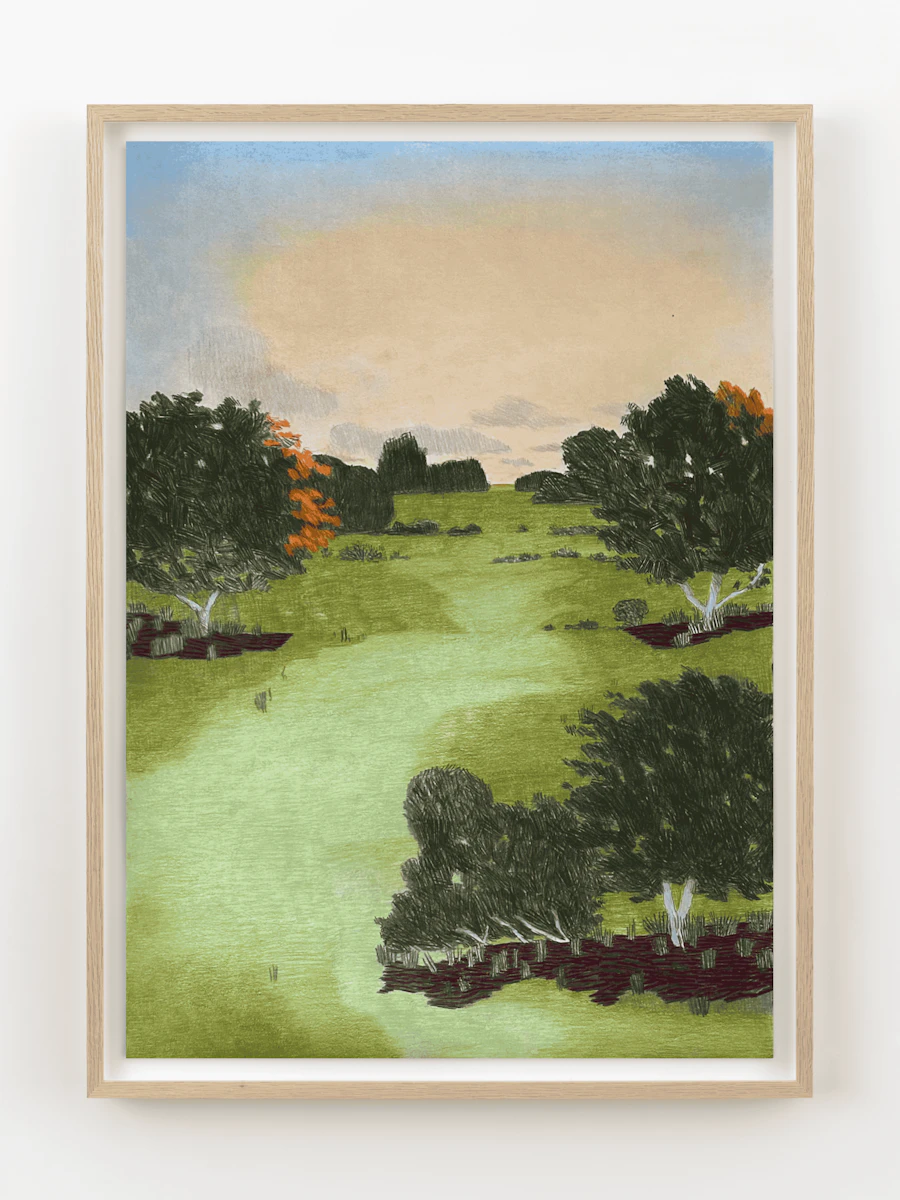
While talking to Per Adolfsen about his new exhibition with Nino Mier Gallery, the artist suddenly reflects: “Looking back, of all the things I’ve done throughout my art career, I feel these works are what I am. This is me.” The pencil drawings Adolfsen shows indeed connect the dots across his various artistic endeavors. Over the years, he has worked abstractly, explored surrealism, and created large, dark, hyper-Nordic expressionist paintings. But ultimately, these current pencil drawings of natural scenes mark a return to what he did, and loved, as a boy. It’s a full-circle moment for the artist. To understand how things reached this point, we need to rewind quickly to when the artist was 12 years old and first encountered Edvard Munch’s paintings in a Norwegian museum. The portraits there completely unsettled him, especially the intimacy and vulnerability in Puberty, 1914–1916. But even more influential for his future path were Munch’s winter landscapes: their thick brushstrokes and bold color contrasts created a quiet, solitary atmosphere that mirrored the painter’s inner state. In that moment, Adolfsen realized that all he truly wanted was to become an artist. That desire never wavered and, over the years, guided Adolfsen back to his original passion: depictions of the natural world. A few years ago, after aforementioned artistic endeavours, Adolfsen committed to a rigorous self-imposed discipline of creating three outdoor drawings every day for a month: an exercise that stretched into a full year and yielded roughly a thousand works. It became a way of living and being. There was no commercial goal, and he could treat those drawings as pure things, not having to view them as artworks but rather as an extension of himself. Through this process, he began noticing recurring patterns in the environment and in his own output. “I started to see how life is constructed,” he explains. “As a human species, we are part of nature. What happens to us can often be traced back to natural processes.” In his art, he mimics nature as honestly as possible: even his linework follows what he sees in the world around him. Just as the natural world is diverse and unpredictable, so is existence. Many artworks in the exhibition carry underlying motifs that reflect episodes from the artist’s own life. Much of the appeal in his art stems from these universal narratives conveyed through landscapes, the artist believes. He also acknowledges that viewers sometimes read a sense of melancholy into his drawings, though he never sets out to create somber works. When it appears, this quiet undercurrent of sadness, loneliness, grief, or longing arises unconsciously and remains only a subtle thread amid a much broader emotional spectrum. After all, such feelings, just like joy or wonder, can be woven into a person’s temperament. They are not simply fleeting moods but part of the lens through which the world is perceived. When this disposition is intrinsic, it naturally emerges in one’s creations. For Adolfsen, genuine emotion cannot be forced or manufactured; the moment an artist deliberately pursues it, the result feels contrived. True depth arises organically, from the core of one’s identity. In this regard, his perspective aligns with the Danish philosopher Søren Kierkegaard, who viewed melancholy not as a transient mood but as a profound condition of inwardness that shapes one’s entire experience of reality. Some might assume that moodier works in the show, such as In Grey, 2025 or Dusk Winter, 2026, stem directly from the artist’s emotional state. In truth, Adolfsen sees himself as more rational than emotional. The rainy vistas, autumnal scenes, and wintry views simply reflect the surroundings he observes. They mark a return to the grayscale palette he favored earlier in his career and felt liberating to revisit, reconnecting him with Nordic expressionist traditions. He is well known for producing many of his smaller drawings en plein air, directly in contact with the landscapes he renders. Sun or rain makes no difference; each condition simply provides a fresh viewpoint. Working outdoors offers an escape from everyday routine and ordinary pressures. What stands out as new and striking in Shaped by the Wind are the larger-scale artworks, which practical limitations forced him to create indoors. Thematically, however, they remain consistent with the rest of the show: all rooted in his immediate surroundings. Whereas his first solo exhibition with the gallery, Lava (2024), drew heavily from time spent amid the volcanic terrain of the Canary Islands, this one brings him back to Denmark’s flora and fauna. For his works, he deliberately restricts himself to colored pencil, graphite, and chalk. Yet to him, this limitation does not constrain creativity: “The more I limit what I’m allowed to use, the greater sense of freedom I feel.” The selection of works is, much like the natural world itself, varied and eclectic. Adolfsen has no interest in presenting artworks that are uniform in theme or style. “As people, we are complex and multifaceted,” he says. “The exhibition should reflect that.” He presents nature as it truly is: wild, unpredictable, moody, uplifting, and above all, beautiful. He invites viewers to engage with its splendor openly, without overanalyzing, simply allowing its wonder to wash over them. This childlike approach offers a way to reconnect with the everyday marvels we so often miss as we age. Per Adolfsen (b. 1964 Odense, DK; lives and works in Odense, DK) has had solo exhibitions at Dianna Witte Gallery, Toronto, CA; The Anzai Gallery, Tokyo, JP; Sobering Galerie, Paris, FR; Gallery Thomas Jaeckel, New York, NY, US; among others. Group exhibitions include RHODES Contemporary Art Gallery, London, UK; Knust Kunz Gallery, Munich, DE; Alexander Ochs, Berlin, DE; and Christoffer Egelund, Copenhagen, DK. Shaped by the wind is his third solo exhibition with Nino Mier Gallery.Opening Hours
| Monday | Closed |
| Tuesday | 10:00 - 18:00 |
| Wednesday | 10:00 - 18:00 |
| Thursday | 10:00 - 18:00 |
| Friday | 10:00 - 18:00 |
| Saturday | 10:00 - 19:00 |
| Sunday | Closed |