A legend tells that one day Saint Augustine was walking along the shore, lost in thought about the mystery of the Holy Trinity. Struggling to grasp this doctrine through reason alone, he saw a child who had dug a small hole in the sand and was diligently pouring seawater into it, one shellful at a time, intending to empty the entire ocean. When Augustine pointed out the impossibility that such vastness could ever fit into so small a space, the child replied that even more so could Augustine not contain the nature of God within his limited mind. This tale left a lasting mark on the artist during her elementary school years, when a teacher shared it with the class. For her, it captures a profound truth: not everything in existence can be fully comprehended in clear, logical terms. Some vital...
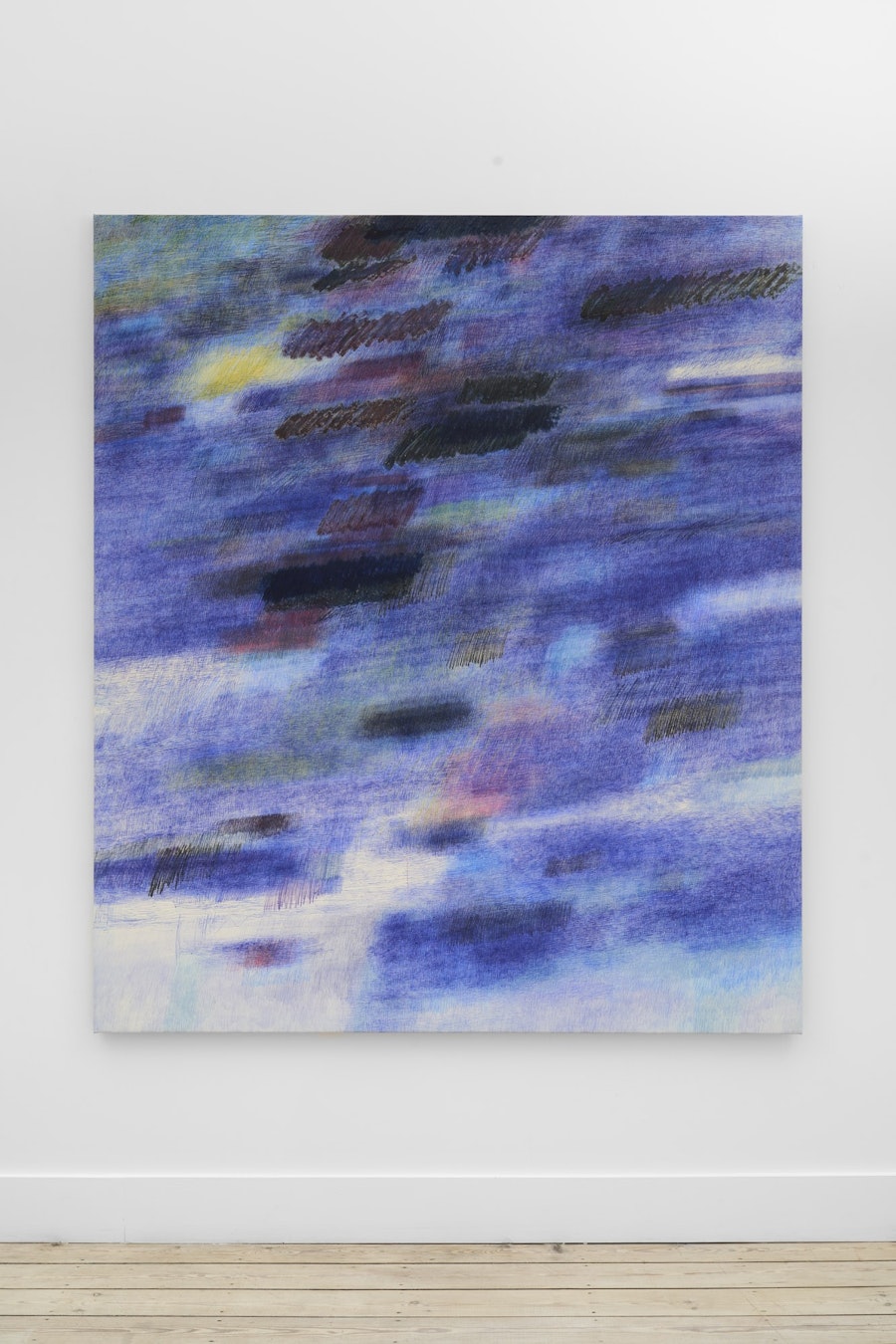
A legend tells that one day Saint Augustine was walking along the shore, lost in thought about the mystery of the Holy Trinity. Struggling to grasp this doctrine through reason alone, he saw a child who had dug a small hole in the sand and was diligently pouring seawater into it, one shellful at a time, intending to empty the entire ocean. When Augustine pointed out the impossibility that such vastness could ever fit into so small a space, the child replied that even more so could Augustine not contain the nature of God within his limited mind. This tale left a lasting mark on the artist during her elementary school years, when a teacher shared it with the class. For her, it captures a profound truth: not everything in existence can be fully comprehended in clear, logical terms. Some vital and more mysterious realities, such as beauty and love, we can only glimpse, experience briefly, and attempt to pursue further and further. This inquiry permeates Gatti’s intense body of work, from intimate pieces on paper to expansive canvases. The title of her first exhibition with Nino Mier Gallery, Il Colore del Tempo (“The Color of Time”), echoes this theme of the ineffable. What tone does time possess? Viewing the works on display, one might propose blue. Yet she deliberately refrains from providing a definitive answer, instead offering her art as an open invitation for each viewer to discover personal meaning and interpretation. Spanning roughly the past three decades, the selected works were chosen to harmonize with the Brussels gallery space. She views the exhibition not as a retrospective but as a thoughtful, if somewhat arbitrary, cross-section of her extensive output. The guiding tension here lies between a renewed engagement with the past and an anticipation of what lies ahead. “I experience my work as lyrical,” she explains. “It feels like moving from one beginning to another. That’s how I experience it: the work is constantly changing.” Gatti’s artistic journey unfolds across the exhibition. It begins with the enigmatic, monochromatic grays of her 1990s black-and-white works, shifts to the striking cobalt-blue architectural forms of the early to mid-2000s, then incorporates greens, yellows, and reds, and more recently introduces new colors and transparency. Nature, wide spaces and horizons, and especially the mountains where she enjoys long walks, have long been a source of inspiration. She compares her successive creative phases to climbing different peaks: each route presents unique obstacles and revelations, and every summit offers a distinct panorama. Though varied, they share an underlying beauty. Hailing from Turin and favoring an accessible, everyday tool like the ballpoint pen, Gatti naturally invites comparisons to Arte Povera, particularly Alighiero Boetti’s ballpoint-pen Ononimo series (1973). While acknowledging the possibility of unconscious influence from that movement, she approaches the association cautiously. Unlike Cy Twombly or Sigmar Polke, who wielded the ballpoint pen for irony, critique, or the subversion of ordinary materials, Gatti treats it more as Lucio Fontana did: as a precise, functional instrument for exploration with minimal resistance. Her choice is pragmatic rather than declarative. She also dismisses rigid distinctions between drawing and painting, seeing them instead as coexisting, meeting at their shared boundary. Working on a grand scale with ballpoint pens might seem intimidating, yet for Gatti it never becomes a chore. She values the directness of the marks, which allow her to draw while moving, letting her hand trace the flow of her thoughts. This is why she describes her art as corporeal rather than purely abstract. She begins each piece with a vision but welcomes spontaneous impulses and fleeting intuitions to shape the outcome. The process matters deeply to her. Larger canvases demand hours of repetitive mark-making and consume dozens of pens; some works evolve over years of intermittent effort. This duration once again ties back to the theme of time. The expansive surfaces, scaled to the reach of her body and arm, embody the indivisible fusion of gesture, space, and temporality that defines Angiola Gatti’s work. “I like this accumulation of matter and time, and of thoughts, of different moments in my days, the changing light, the ordinary events of everyday life. All are inside my work.” Angiola Gatti (b. 1960, lives and works in Turin, IT) studied at the Academy of Fine Arts and the University of Turin, IT. Gatti has had solo exhibitions at Ryan Lee gallery, New York, NY, US, villa Clerici, Milan, IT, museo Ettore Fico, Turin, IT; Istituto Italiano di Cultura, Hamburg, DE, villa Giulia, Verbania, IT and Car drde gallery, Bologna, IT. Her recent group exhibitions have been with East gallery, Strasbourg, FR; Fondazione del Monte, Bologna, IT, 104 Centquatre exhibition center, Paris, FR and Stuart Shave/modern art, London, UK. Gatti’s works are held in the public and private collections of museo Ettore Fico, Turin, IT, Balbo, Turin, IT, Isorropia Homegallery, Milan, IT, Nerio e Marina Fossati, Como, IT, BIC Collection, Clichy, FR, FRAC Auvergne, Clermont-Ferrand, FR and the Minneapolis Institue of Art, Minneapolis, MN, US, among others.Opening Hours
| Monday | Closed |
| Tuesday | 10:00 - 18:00 |
| Wednesday | 10:00 - 18:00 |
| Thursday | 10:00 - 18:00 |
| Friday | 10:00 - 18:00 |
| Saturday | 10:00 - 18:00 |
| Sunday | Closed |