Davy Depelchin
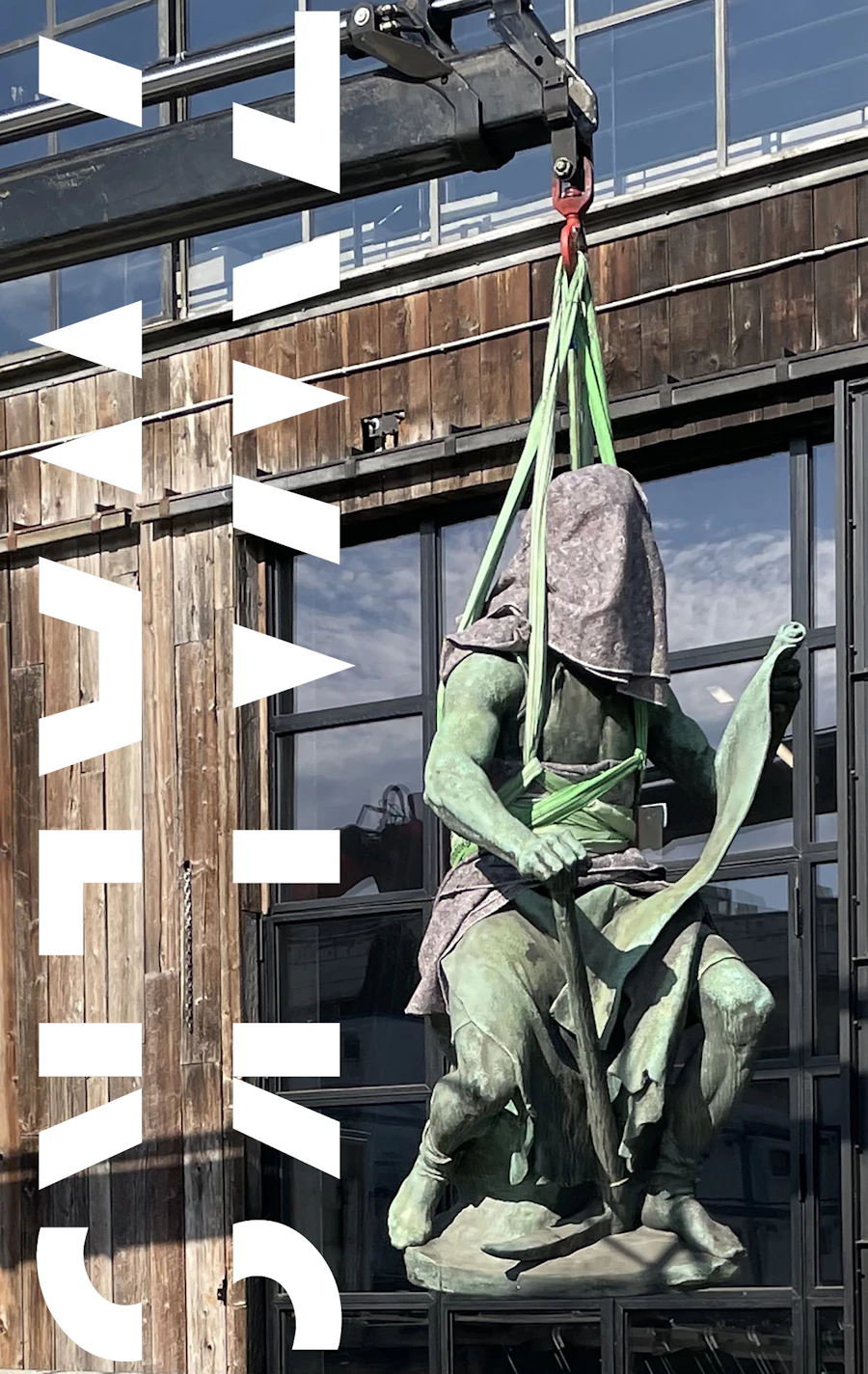
Le Travail, a sculpture by Guillaume De Groot that disappeared from public space opposite Kanal, anchors the project. Designed in 1879 and cast in 1890, this allegory of labour threads through an exhibition of archival material and an experimental chatbot that connects histories of labour to contemporary questions about AI, automation and democracy. The exhibition's title recalls the Salon de Monplaisir, the first "people's house" in Brussels, situated on a site the museum overlooks today. There, nineteenth-century weaver and playwright Jacob Kats used theatre and public meetings to raise workers' awareness of their rights. From this installation, a series of public walks unfolds across the canal area. Local socio-cultural organisations working on inclusion and the right to work play a central...
Le Travail, a sculpture by Guillaume De Groot that disappeared from public space opposite Kanal, anchors the project. Designed in 1879 and cast in 1890, this allegory of labour threads through an exhibition of archival material and an experimental chatbot that connects histories of labour to contemporary questions about AI, automation and democracy. The exhibition's title recalls the Salon de Monplaisir, the first "people's house" in Brussels, situated on a site the museum overlooks today. There, nineteenth-century weaver and playwright Jacob Kats used theatre and public meetings to raise workers' awareness of their rights. From this installation, a series of public walks unfolds across the canal area. Local socio-cultural organisations working on inclusion and the right to work play a central role. Together, participants consider whether AI-driven acceleration makes the right to exist an even more urgent claim. Artists, researchers and local residents join participants in seven walks to explore work, property, technology, collectivity, social justice, human rights and art as an emancipatory tool. Walking becomes a method for sharing knowledge, exchanging experiences and imagining new forms of citizenship. The project culminates in the Banquet of Ideas, a symposium that builds on conversations begun during the walks. By connecting past and future, 7 Walks (Salon Monplaisir) creates space to reflect on labour, technology and democracy in a rapidly changing society – not only on the world we have inherited but also on the world we want to shape together.Opening Hours
| Monday | Closed |
| Tuesday | Closed |
| Wednesday | 11:00 - 19:00 |
| Thursday | 11:00 - 22:00 |
| Friday | 11:00 - 19:00 |
| Saturday | 11:00 - 19:00 |
| Sunday | 11:00 - 19:00 |